Fans of Rachid Taha? This blog is YOUR multilingual community crossroad to share pictures, concerts reviews, news, interviews, links, articles! Fans de Rachid Taha? Ce blog est VOTRE carrefour communautaire plurilingue où partager photos, reportages sur ses concerts, infos, interviews, liens, articles! Esto blog es VUESTRA comunidad multilingue donde reunir fotos, reportajes de sus conciertos, noticias, entrevistas, links, articulos! THE TAHAFANBLOG WITH YOU FROM 2004!!!

Showing posts with label article in english. Show all posts

Thursday, April 24, 2008

Exclusive review and more pics of Rachid's concert in London at Jazz Cafè.

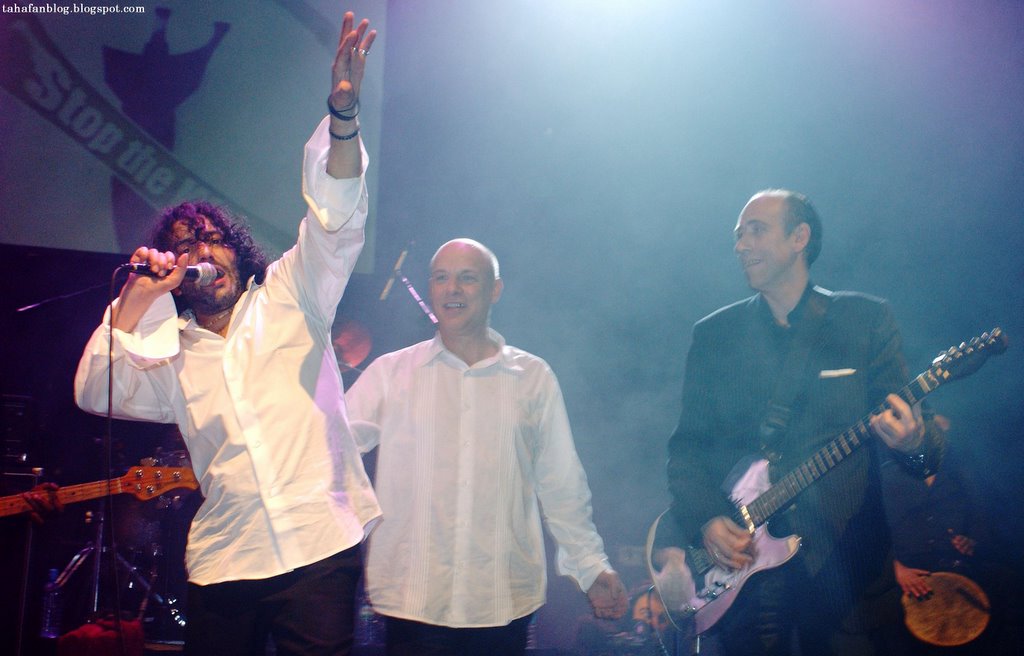
Lyes Taha, Rachid Taha's son, on stage with his father in London at Jazz Cafe

Taha in London at Jazz cafe

Taha in London at Jazz Cafe

Taha in London at Jazz Cafe

Taha in London at Jazz Cafe

Taha in London at Jazz cafe

RACHID AT JAZZ CAFÉ 15TH APRIL
by Yvonne Mitton


Lucky London, it’s been treated to a Taha fest of 3 gigs within 6 days. On Thursday 10th April, as the winner of the North Africa and Middle East category for Diwan 2, he closed the ceremony for the prestigious BBC Radio 3 Awards for World Music at Dingwalls with a one hour set (three numbers of which were broadcast on Friday 11th April). This was followed by 2 nights (Monday 14th/ Tuesday 15th April) at the Jazz Café celebrating the 50th anniversary issue of Songlines magazine. Rachid seems to have a special place in his heart for the UK and he certainly has a loyal, enthusiastic and substantial community of fans here as was obvious in the animated atmosphere at Jazz Café where a lot of meeting and greeting between fans went on before the show. In an interview with Eddy Lawrence for Timeout, Rachid bemoans the fate of his music in France and says ‘Britain is one of the few places which treats him as a mainstream musician’ .

We made the round trip of 160 miles (260 kms) for Tuesday’s gig and found ourselves in a packed and heaving Jazz Café. It was a typical night out with Rachid, raucous, spontaneous and a bit of a party ~ the intimacy of venue made it a loud, sweaty, physical evening, Rachid prowling round the cramped stage in well-worn white winkle pickers and engaging in his habitual banter with the audience.

The band line-up included the familiar faces of Hakim on mandolute, Rachid Belgacem on percussion and Yves on keyboards with the addition of a three piece brass section, essential to the opening song, Ecoute Moi Camarade from Diwan 2. Well known and well loved by the audience, who could sing-a-long word perfect, the rest of the numbers were mainly from his albums, Made in Medina and Tekitoi? ~ Barra Barra, Medina, Shuf Shuf, H’asbu-hum and more ~ for Safi he was joined by two rappers, one of which was his son, Lyes.

Super fan David, who came over from Spain for both nights, told me he has seen Rachid 17 times (makes my 10 look limp ~ I’ve a lot of catching up to do!). He and his travelling companions ,les femmes des chapeaux, complete with red straw cowboy hats, encouraged by Rachid, jumped up to dance enthusiastically on the already over crowded stage. Sadly we had to leave before the end to catch our last train but the evening looked set to carry on well beyond anyone’s last train...

Yvonne

Saturday, July 07, 2007

Glastonburry 2007

An African triumph for Glastonbury's best-kept secret.
by Robin Denselow (Tuesday June 26, 2007 The Guardian.)
A review about the Africa Express performance featuring Rachid Taha at Glastonbury Festival (22nd, 23rd and 24th June 2007).

"This, surely, was the bravest event at Glastonbury this year. It took place away from the crowds and television cameras, and involved a who's who of African stars and an array of western celebrities. Few festival-goers even realised that it was happening, but that, it seems, was the intention. Damon Albarn said he favoured the low-key approach... "because I love that word-of-mouth thing".

Africa Express is that musical rarity: a genuine experiment. Started by a group including Albarn as an angry reaction to the lack of African artists at Bob Geldof's Live 8, it turned into a forum where African and western musicians could work together - though its events have been so secretive that it appeared to have become an exclusive musicians' club. Now, at last, it had gone public, with a little-publicised, five-hour show that could have been a disaster. The aim was spontaneity: no one knew in advance exactly who was going to turn up, or who they would decide to perform with.

Amazingly, it worked. It started with the stirring Malian duo of Amadou and Mariam, now backed both by the rousing brass of the Kick Horns and by Billy Bragg, who then segued cleverly into the Leon Rosselson song The World Turned Upside Down. This 17th-century English history lesson was suddenly transformed by a sturdy Malian improvisation. "Who was that?" asked Bragg, coming off stage. It turned out to be Soumaïla Kanouté, a singer from Toumani Diabaté's Symmetric Orchestra. Toumani, the world's greatest kora exponent, was joined for a glorious collaboration with the Senegalese star Baaba Maal, while the new Somali hip-hop celebrity K'Naan later shared the stage with Algerian punk rocker Rachid Taha. K'Naan and Amadou reappeared during the rousing set from desert-blues exponents Tinariwen. And so it went on.

The Africans clearly found it easier to collaborate than some western musicians, but there were exceptions. Norman Cook, aka Fatboy Slim, played one of his shortest ever DJ sets, wisely choosing the Fela Kuti song Zombie, so that Kuti's one-time drummer Tony Allen, could join in while Damon Albarn and Baaba Maal now added vocals. Indie rockers the Magic Numbers also did well, attracting Bragg and Taha for People Get Ready, while the finale included Rachid Taha's furious treatment of the Clash classic, Rock El Casbah, helped by the full cast.

It was an extraordinary, historic set, and my sympathies to all at Glastonbury who never knew what they were missing. "

Saturday, February 10, 2007

Diwan 2 is Taha’s masterpiece for All about jazz!

Great review of Diwan2 by Jeff Dayton-Johnson in www.allaboutjazz.com

I'm copying it here for our archives (original position here)!

"It is tempting to view Diwan 2 as a “roots” album: there is a preponderance of covers of older material, and the instrumentation leans substantially less on distorted electric guitar than did Rachid Taha's last album, the phenomenal Tékitoi (Wrasse, 2004). As on that album, the musicians—notably guitarist Steve Hillage, mandolute player Hakim Hamadouche, percussionist Hossam Ramzy and the string ensemble—perform beautifully. Hillage's production and Taha's arrangements likewise shine.
The new album is a roots album, but with two important caveats. First, in an important sense, all of Taha’s music is roots music; and second, the roots in question are to be found in the desolate French banlieues as much as they are in Taha’s native Algeria.
The Arabic music was equally present on Tékitoi, where Taha was likely to segue from full swirling Cairo string section, with lute and Arabic percussion, into a techno groove or an electric guitar and screaming vocal that would sound at home on a Nirvana record. Not so much Nirvana this time round, but the point is this new record is not a return to Arabic roots, for Taha never left them behind.
Moreover, in Taha’s music, a rock and roll sensibility is wound around those Arabic roots, as impossible to disentangle as a double helix of DNA. Sometimes the mesmeric North African beat masquerades as rock and roll, as on “Ah Mon Amour” or “Joséphine” from Diwan 2: this was the approach of the great Moroccan chaabi band Nass El Ghiwane (one of whose songs Taha covered on his first Diwan album in 1998). Nevertheless, Nass El Ghiwane looked like rock stars but sounded essentially Maghrebi; by contrast, when rock and roll guitar is added to Taha's songs, it’s clear we are in the presence of genuine cross-cultural fusion.
Indeed, Taha’s best fusion—“Safa,” from Tékitoi, or, more subtly, most of the numbers here— provokes excitement, I would argue, because of an aesthetic similarity between the larger-than-life Egyptian urban music of the 1950s and 1960s and the larger-than-life rock and roll of the next few decades. Both forms take delight in the grandiosity of their orchestral sound. Thus, on Led Zeppelin’s “Kashmir,” or Taha’s “Rani,” on this record, what one hears is the unabashed joy of like recognizing like. As Duke Ellington said in Afro-Eurasian Eclipse (Original Jazz Classics, 1971): “It’s hard to know who is enjoying the shadow of whom.”
There has been some carping about Taha’s vocal abilities as he takes on the Egyptian late classical tradition. Diwan 2 closes with no less than than Oum Kalsoum’s “Ghanni Li Shwaya” (clocking in at under seven minutes, Taha's performance devotes a tiny fraction of the time that Kalsoum would have accorded the number). Taha is no Oum Kalsoum. And I don’t think he’s trying to be. His vocal gifts are somewhat limited, in the way that one would describe Louis Armstrong’s or Bob Dylan’s vocal gifts as “somewhat limited,” but like those musicians, Taha deploys his talents with great agility. His delivery draws amply upon learned and popular Arabic music, particularly North African, but he seems equally influenced by the French chanson, where quirkiness is embraced (if not de rigueur), and by Anglo-American rock and rhythm and blues.
What one hears in the repertoire compiled for Diwan 2 is not so much the classic Egyptian sound of the 1950s and 1960s, but the music of Taha’s childhood in France, where he moved at the age of ten. Thus there are songs that might have come from his parents’ record collection (Oum Kalsoum, Abdel Halim Hafez's “Gana El Hawa”), from the radio (Mohamed Mazouni’s “Écoute-Moi Camarade”), and from Oran, the Algerian city from which Taha’s family hailed, songs the family would know (“Rani” and “Mataoul Dellil,” here delivered with orchestral sumptuousness.) The historical era thus recalled is a painful one, as a generation of immigrants’ children tentatively sought to find their means of cultural expression in a society that looked askance (and still does) at the notion of cultural diversity.
Seen in this light, the inclusion of Cameroonian Francis Bebey’s amusing “Agatha,” with light-hearted kora accompaniment, might be an understated overture on Taha’s part towards immigrants from south of the Sahara. Then again, maybe he just liked the song.
Diwan 2 does not have the flash and dazzling immediate impact of Tékitoi; but what it lacks in surface sheen it makes up for in even greater depth. This may be Taha’s masterpiece. "

Sunday, May 07, 2006

Rachid in Athens at the 4th European Social Forum!

Wakka Wakka
As told us by beatlus (thaaaaanks: efxaristo poli) who gently added a comment to my former post, we now know where Rachid performed in Greece on the 5th of May: he sang at the 4th European Social Forum (from the 4th to the 7th of May 2006) that organized a multi-concert at the old airport of Athens! Rachid was on stage after Bainak, Earthbound, Les Ongles Noirs and Amparanoia. Here is the proof! If anyone has pictures or report of this event, you are welcome! Contact me!
"The Social Forum is one of the major events of the movement against neoliberal globalization and war, deregulation of labor and poverty, climate change and environmental destruction, violation of democratic rights and sexism, racism and the threat of the far right." (www.socialrights.org)
kelma

Monday, December 05, 2005

I think I’m gonna have to tell the whole universe about Rachid Taha!

Thanks a lot Anthony for the following original view on Rachid's music and review of his performance in London!

The Rachid Taha Band (Astoria London – 27 November). Support – Brian Eno + Nitin Sawhey + Imogen Heap. Presented by Brian Eno and Stop the War Coalition.
By Anthony Cannon.

The last time in was in this grotty rock ’n’ roll amphitheatre was over ten years ago to see Blixia Bargel – the guitarist with Nick Cave – playing with his other band, Einstürzende Neibauten and I watched them spew out a brilliant demented, industrial racket. That night I was guzzling Jack Daniel and I thought I was the son of the devil. Well, haven’t times changed! Tonight I’m many years older, wiser and I’ve been reduced to seeing one of those “world music” artists. Why? Because I love my girlfriend and she loves Rachid Taha. I should warn you though, first she is a girl and second she’s Italian so she obviously knows jack shit about music!

Rachid Taha London 27th Nov.2005 15

So here I am drinking mineral water and surrounded by one of those annoying eclectic audiences of the young and old. You know, earnest looking foreign students (who are wasting their time at college by actually studying) mixed in with grown men who are refusing to grow up and forty-something females who refuse to dye their hair, instead they parade their greyness ‘cos they’re intellectuals and not sex objects”. After analysing the demographics I’m thinking I should’ve stayed at home and watched tv when Imogen Heap appears on stage with some strange headgear, that makes her look like a sort of floral display, and were off to her wonderland of synthesized floating, wistful sounds and fluffy cloud lyrics. Yes, she has a great voice and yes she has well crafted songs but I’m bored. Let’s not be too unkind though, this is all in aid of a good cause.
Mr Eno and Nitin Sawhney give us a couple of improvised songs that are far more interesting. Eno was tapping away at some little electronic thing creating a moody and sinister backdrop to some of Nitin’s traditional Asian vocals. I was pretty impressed with Nitin on the Spanish guitar and they played-out with a catchy, solid riff (not something you often get on this instrument) backed by the steady, pounding thud on some real animal skin.
After a lengthy delay - old trick that one - Mr Taha’s band makes a well received but rather unimpressive entrance, none of these guys are gonna be biting the heads off bats, I thought. Then the man himself arrives all dressed in black. He’s wearing a leather trilby, orange shades and he mooches on stage with a slightly comic swagger. The band get straight to business and the audience are loving it already. This is definitely a meeting of musical cultures here but I can’t see the join. They’re both there, the energy and anger of rock and a swirling, eastern mysticism that’s very alluring and seductive, and, it’s making the women wriggle like belly dancers.
The second song sounds to me a lot like Bo Didley, nothing wrong with that. The guitar player is in a world of his own, he’s a whirling dervish, armed with six strings. Rachid’s no giant, I wouldn’t give him more than five’ five’’, but between him and the guitar player they more than fill this stage. The music is uplifting, it doesn’t claw or kick, it’s a tidal wave and it picks you up and carries you off. We’re all riding on Rachid’s magic carpet as he dips and dives and twist and turns through some wonderful songs.
And there’s no let up here. Their material is all upbeat and vibrant with only the occasional gentle moments to give Rachid a break. All around me the eclectic geeks have turned into proper rockin’ dudes. It’s not like the Ramones, they’re not killing each other, but you can tell they’re having a real good time. I realise I’m in the presence of some die-hards fans and I’m beginning to see why. Rachid is charismatic, his wailing voice conjures that exotic feeling of the Islamic world and when he dances with his arms outstretched he’s like Zorba the Greek, loving life and loving his music.
We know it’s coming to an end (and that we’re gonna hear Rock the Casbah) when Mick Jones saunters on stage and put on his silver-plated telecaster. This has become Rachid’s anthem and I think it’s a bit clichéd so I’m praying he doesn’t end it all here. Then there’s a second encore with my personal favourite, Ida, which has this brilliant, infectious brass that makes you just wanna dance. After that I’m thinking, quit while you’re ahead, but no, the audience and Rachid are up for one more magic carpet ride and just when you thought there was nothing left in the tank The Rachid Taha Band really turned the heat up with Garab. It’s a great end to a great gig.
A parting question, is this world music? Who gives a damn! I know one thing for sure; this man and his music do really cross barriers and I guess those eclectic geeks, and my girlfriend, knew more than me. I think I’m gonna have to tell the whole universe about Rachid Taha. But now that I think of it, let’s keep him as our little, magical secret so we won’t have to go and see him playing in some bloody stadium.
Anthony Cannon

Wednesday, November 30, 2005

Independent Review of The London gig!

Rachid Taha, Brian Eno, Mick Jones

Click on the image to enlarge/Cliquez sur l'image pour la voir en grand.

Stop The War Benefit Concert: Brian Eno/Imogen Heap/Nitin Sawhney/Rachid Taha, Astoria, London
A riotous night for peace

By Tim Cumming
Published: 29 November 2005, The Independent.
Sent by Rikki Stein, with courtesy, as well as the picture!

It's rare for Brian Eno to grace a British stage now-adays, especially in the context of rock music. You are more likely to encounter his work in art galleries than in the lager-and-concrete grunginess of a rock venue like the Astoria. In recent years, though, he has also involved himself in humanitarian causes such as the charity War-child, and, since 9/11 and the launch of that piratical ship of state The War on Terror upon an unbelieving world, his voice has been prominent in the Stop the War movement, and tonight's gig is a fundraiser for the charity.
Befitting our modern fractal realities, Bring Our Troops Home banners hang beside posters for the launch of the new Girls Aloud album. Punters pay in cash only at the door, and there's a Stop-the-War sign-up stand behind the mixing desk, but other than a brief opening address delivered by Eno about the humanitarian waste and pointlessness of the occupation, the stage is cleared of rhetoric or exhortation, and the raw spirit of the music holds reign.
Imogen Heap's intricate one-woman electronica opens the show, with a short set orchestrated from what looks like the contents of a hi-fi showroom c2012, the banks of electronica twinkling around her like digital fairy lights. Heap has come to prominence via the use of her music on the cult television show The OC and the hit American indie film Garden State, and her shimmering, semi-translucent musical universe is without easy compare.
Her dreamlike set segues well into Sawhney's short, beautifully textured and largely instrument performance, with Sawhney on guitar accompanied by a percussionist and Eno, standing at the back wearing the bemused-cum- impish countenance of a past master of benign disruption, and adding sweeping, poetic techno textures to Sawhney's Arabic-style picking.
Eno resumes his station on a raised platform in front of a row of laptops and gizmos as Rachid Taha's crack seven-piece band storm the stage and play merry hell with the next two hours. Eno calls Taha's music the emanation of "punk Arab consciousness", and from the Arabesque opening of "Mamachi", from Taha's most recent album, Tékitoi (Who Are You?), the packed Astoria audience get a pure emanation of that consciousness in action.
Taha has visited Britain frequently over the last few years, but this is surely one of the best concerts he has delivered. He takes the stage in a skinny black suit and leather trilby, saluting both his musicians and the crowd, twisting his body at the microphone as the song mutates into a driving Arabic rock beat. The opening salvo includes the pounding "Shuf [Look]" and the superb "H'asbu-Hum" ("Ask Them for an Explanation").
Taha looks like an archetypal rock'n'roller, and the band's guitarist Noel Delfin knows all the moves, but the music has almost nothing, apart from volume and mass, to do with the long tradition of Anglo-American Blues-based rock - the very foundations of the beat are quite different.
Eno knows this, and throughout the set adds atmospheres and textures to heighten and sharpen Taha's sound - high, keening oscillations, deep bass notes, minimal "root" sounds, such as the fantastically effective but simple two-or-three-note keyboard riff that plays underneath the song "Medina".
For the night's grandstanding conclusion, the Clash legend Mick Jones strides on in a skinny black suit and plays probably the most exciting guitar he has delivered in years. He and the band are brilliant on Taha's definitive take on "Rock the Casbah", for which the audience goes berserk, and Jones chops out some supremely dirty punk chords through the four encore performances, concluding with a pounding, tribal "Tékitoi". Then, after much bowing and salutations to the crowd, Taha and his boys bid farewell.

... little jump to our links on this gig? Un petit saut vers nos liens sur ce concert?:

Yvonnes' review, photos one, two, more from the Independent.

kelma

Monday, November 28, 2005

Yvonne's review of Eno&Rachid's gig in London!

Rachid Taha and Brian Eno ~ Stop The War Coalition Concert ~ Sunday 27th November. By Yvonne Mitton

"Well, if Rachid Taha feels invisible in France [BBC Radio 4 Today Programme interview] he’s certainly very, and frequently, visible here in the UK. The Astoria was heaving to the rafters last night [Sunday] for the Stop the War Coalition concert.

The whimsical Imogen Heap and the aesthetic Nitin Sawhney barely prepared the way for the blast, the wall of sound that is theRachid Taha Band, as they were billed. Standing at the crash barrier in front of the stage was injurious to health in more ways than one ~ but I don’t mind my health being seriously threatened by Monsieur Taha once in a while! Anyone expecting, or even wanting a Taha concert to be a reprise of the genteel Diwan, forget it, he’s moved on ~ retreat to a safe distance, preferably leave the building, if you can’t take it! Last night would knock more than your socks off. As per usual, he belted out, numbers fromTekitoi? and his back catalogue, with an incredible energy that makes younger men look comatose. The audience were with him all the way, for most of the time it was sing-along-a-Rachid. The charisma and magnetism of the man is phenomenom to behold ~ we met up with five fans from Spain who had flown in purely for this concert and certainly didn’t regret it. Brian Eno on his Kaoss drums and as chorus was obviously loving every minute of it ~ his first appearance on the UK stage since 1979.

Now if that doesn’t tell you something about the respect and support that Rachid Taha is attracting from the great and good what will? Mick Jones, to the delight of the crowd and looking wonderfully be mused and blokey, strolled on mid-way to join Rachid et al in Habina and remained for the rest of the performance including the two encores, culminating in the frenetic Garab.

Rock on Monsieur Taha!!
I’m going back to bed now!!

Yvonne Mitton (all rights reserved)."

N.B: exclusive pics will follow in the next days!!!!!!!!!!!! kelma

Brian Eno explains why he decided to play on stage with Rachid!

"Hi all! I'm sending this out to a far wider constituency than previous communications on the subject, because I wanted to provide its recipients with the opportunity to read the attached article that appeared in today's Independent newspaper, written by Brian Eno which eloquently explains why he was drawn to working with Rachid Taha. More importantly, though, it provides the most persuasive reasons for which, no matter what your political, or religious persuasions, support for the war in Iraq simply cannot be defended." Rikki Stein

Brian Eno: Taking the world by storm
Brian Eno rarely plays live, but this Sunday (27th of Nov.) he'll be on stage at a charity gig, playing punk Arabic music. He explains why .
Published: 25 November 2005 , The Independent.

"I will be appearing on stage with Rachid Taha at a benefit concert on Sunday, singing live backing vocals in Arabic (Rachid has helped me with the pronunciation). It is mainly to raise money for the Stop the War Coalition, but it also shows that a bunch of Muslims and so-called Christians can quite easily work together on projects like this. I rather like the flyer we sent out, with a picture of Rachid looking like a dirty Arab giving me a big kiss on the cheek. I also support Rachid's music for its ability to disrupt. It's not because it makes a specific political statement, but I think it would probably be the greatest social revolution in America if American kids started liking Muslim music, like they once loved Elvis or reggae.
You can't imagine how happy it makes me feel when I am up there playing this punk Arabic music, live with Taha's band. I don't often perform live these days - the last time I was on stage in Britain was about four years ago, with the Brazilian Caetano Veloso - because being on stage doesn't interest me generally. But I have played with Rachid, who is an Algerian-born singer-songwriter, three times this year in Paris, Moscow and St Petersburg. I have enjoyed that more than any other stage experiences I've ever had.
This is because it is great being in a big band - there are seven in Rachid's - without much responsibility. There is so much energy to this new music - I call it "punk Arab consciousness" - and I just wish all those guitar bands doing Talking Heads remakes would wake up and listen to what's going on in the rest of the world.
I don't expect you will see a concert quite like this for some time. Mick Jones will be coming on for "Rock the Casbah", because of course, Rachid recorded his own version, "Rock el Casbah". The line-up for this concert - with Nitin Sawhney and Imogen Heap - is pretty amazing
A friend of mine, the guitar player Leo Abrahams, will also be appearing. His guitar feeds into my processors, and then I can do things that no guitar has ever had done to it before. It sounds like live cut-and-paste with Arabic inflections. I've been experimenting a bit with this sound with Herbie Hancock this year, originally for his album Possibilities, but the track wasn't used in the end. It was probably too weird for them.
My involvement in this concert isn't really so much about politics as it is humanitarian. There is a tragedy unfolding. It's quite as bad as some of the other awful tragedies that have happened this last year, the tsunami and the earthquakes, but it is one we created. I really think we should be trying to do something about it.
The reason I really resent this war, apart from the fact it has hurt a lot of people and caused chaos in the Middle East, is that it has so far cost at least $200bn. According to the World Health Organisations estimates, for that amount of money we could have eradicated malaria from the planet, given everybody on the planet clean water, given every Aids victim in the world the best treatment available. We could have done all those things and we still would have had change. Is this how we are going to spend our resources in the future - on these ridiculous vanity projects?
I have never used my own music as a mechanism of protest. I am not interested in using music in that way - but I think all music has a political dimension because it suggests a way of being. Just as reggae suggested a world where you chill out, in a society in which is desperately driving consumers to be obedient workers in order that they earn enough money to buy goods, Rachid's mix of punk Arabic music says: "Let's take the world by the scruff of the neck, the whole of it, and shake it up". People may think that because Rachid is a Muslim, he is therefore knee-jerk anti-American, but actually he is anti-Arab as much as he is anti-American. He is very coherent when he talks about the failings of the Arab states. His music makes people think: "Do I live in the little world of white rock'n'roll, or do I live in this big world where everything gets absorbed and thrown back out?
What a lot of Arabic music is about is a different way of moving your body - there is a spinning and whirling motion, rather than stomping and getting down. If you listen to some of the melodies in Rachid's tracks, they are very complex. To try to remember them as a Western musician is very hard. They are very elaborate. It is a whole different way of thinking about music. So instead of polarising the West against the Islamic world, Rachid's music merges the two. This is accepting and surrendering to each other's sensibilities - and if we can do this through music, surely we can try to do that in the world. "
The Stop the War Coalition benefit concert is at the Astoria, London, on Sunday (www.stopwar.org.uk; 020-7278 6694)


N.B: Have you read Yvonne's review of the concert?

Saturday, July 09, 2005

Rachid in the US and in Canada: links, reports, interviews!

Thanks to all of U for these links I'm pasting here...

first this... blogged! (with one pic) Then:
27-6 LA:
annoucement with bits of interview
28-6 SF:
announcement with bits of interview
more and a review
1-7 Chicago
2-7 Vancouver annoucement
3-7 Victoria
5-7 Philadelphia:
annoucement and bits of interview!
6-7 NY
7-7 Boston
interview one
interview two
review
from www.sfbg.com

9-7 Quebec

The best quotes from these interviews definetely are the following ones:

"My voice is getting sexier every day." and:

''Politicians," Taha concludes, ''should take more inspiration from music." kelma

Wednesday, June 22, 2005

Rachid at the Meltdown Festival

Rachid was at the Royal Festival Hall in London (last Friday June the 17th) for the Meltdown Festival!

"The Meltdown Festival is a month of music, film and visual arts in and around the South Bank Centre in London. In recent years the event’s moved away from its classical origins towards a more rockcentric theme, thanks mostly to the celebrity curators that have included David Bowie and Scott Walker and Morrissey." (www.french-music.org). Each curator has the opportunity to mix up styles and artists according to their own fantasy... Former curators were: MORRISSEY (2004), LEE ‘SCRATCH’ PERRY (2003), DAVID BOWIE (2002), ROBERT WYATT (2001), SCOTT WALKER (2000), NICK CAVE (1999), JOHN PEEL (1998), LAURIE ANDERSON (1997), MAGNUS LINDBERG (1996), ELVIS COSTELLO (1995), LOUIS ANDRIESSEN (1994) and GEORGE BENJAMIN (1993).
This year, the 13th programming is signed by Patti Smith including Rachid Taha, Tinariwen, Yoko Ono, Sinead O'Connor and many more.
Patti Smith declared: "I am very happy and proud to be part of a festival whose objective is to produce an atmosphere of creative conspiracy. This sense of community from crew to volunteers to performers will be the backbone of our festival. Everyone will draw the best of themselves and happily face new challenges.(...) We will strive to reinforce our cultural voice. We will all work hard, respect one another and also have a good time together. I look forward to exploring new ideas and new possibilities of collaboration" .

So....last Friday Patti Smith performed with Rachid ... and Carbon/Silicon , the new band fronted by legendary Clash man Mick Jones, has supported Rachid's performance. In their site, we find written: "Big thanks to Patti Smith for having the band at the Meltdown Festival and for jamming with us on the Encore of "Hey Joe" (you can see live footage of the song at www.gigvideo.co.uk)...and big thanks to Rashid Taha too for being so cool.. a great night and a great venue... "

Rachid était en concert au Royal Festival Hall à Londres vendredi dernier le 17 Juin dans le cadre du Meltdown Festival!

"Le Meltdown Festival est un mois de musique, cinéma et arts visuels organisé autour du et dans le South Bank Centre à Londres. Ces dernières années, l'événement s'est éloigné de ses origines classiques pour devenir un peu plus "rockcentrique" surtout grâce à certains de ses fameux curateurs comme David Bowie, Scott Walker et Morrissey." (www.french-music.org). Chaque curateur a ainsi la possibilité de mélanger les genres et les artistes au gré de leur fantaisie... Les prècédents curateurs ont été: MORRISSEY (2004), LEE ‘SCRATCH’ PERRY (2003), DAVID BOWIE (2002), ROBERT WYATT (2001), SCOTT WALKER (2000), NICK CAVE (1999), JOHN PEEL (1998), LAURIE ANDERSON (1997), MAGNUS LINDBERG (1996), ELVIS COSTELLO (1995), LOUIS ANDRIESSEN (1994) and GEORGE BENJAMIN (1993).
Cette année la treizième programmation est signée Patti Smith qui a prévu Rachid Taha, Tinariwen, Yoko Ono, Sinead O'Connor et beaucoup d'autres.
Patti Smith a déclaré: "Je suis heureuse et fière de participer à un festival dont l'objectif est de produire une atmosphère de conspiration créatrice. Il y a un sentiment de communauté dans toute l'équipe, y compris les volontaires et les artistes, un sentiment qui sera l'épine dorsale du Festival. Chacun donnera le meilleur de lui-même pour affronter de nouveaux défis. Nous ferons de notre mieux poour renforcer notre voix culturelle. (...) Nous travaillerons dur ensemble tout en nous respectant et en nous amusant. Je me réjouis de pouvoir explorer de nouvelles idées et de nouvelles collaborations".

C'est ainsi que vendredi soir Patti Smith s'est produite sur scène avec Rachid et que Carbon/Silicon , le nouveau groupe de Mick Jones, ex-Clash, a également participé. Dans le site de ce groupe, on trouve écrit: "Un grand merci à Patti Smith pour avoir invité notre groupe au Meltdown Festival et pour avoir jammé avec nous sur le Encore de "Hey Joe" (la chanson en live sur www.gigvideo.co.uk) et un grand merci à Rachid Taha aussi, super cool.. une grande soirée et un grand spectacle..."

Meltdown 17 June 2005 3


Meltdown 17 June 2005 2

Meltdown 17 June 2005

Meltdown 17 June 2005 4
Rachid and Patti Smith

All exclusive pics by enta for the tahafanblog!
Photos exclusives par enta pour le tahafanblog!

Other great pics (not by enta!!!! by amanda...) by going to this gallery!
Il y a d'autres photos (mais pas faites par enta... , prises par amanda!) en visitant cette gallerie!

kelma

Monday, May 09, 2005

Rachid in Fes (Morocco) May 11th with a conference on darja pure rock!

menara.ma announces Rachid's concert in Fez (Morocco**) on May the 11th with a nice article and a conference "around" him by sociolinguist Dominique Caubet (the translator of his songs on Tekitoi) at the Institut Français the day before: "darja* pur rock". The original article (in French) follows, with, below, our translation into English.

menara.ma annonce le prochain concert de Rachid à Fès (Maroc**) le 11 mai avec un bel article ainsi qu'une conférence "autour de" l'artiste par la sociolinguiste Dominique Caubet (la traductrice de ses chansons sur Tekitoi) à l'Institut Français le jour avant: "darja* pur rock".

"CONCERT DE RACHID TAHA à Fès : Mercredi 11 mai 2005, 19h30, Collège La Fontaine.

Rachid Taha est surtout connu sur le plan international pour sa reprise du titre de Dahmane El Harrachi, Ya rayah, chanson du chaâbi algérois ou pour sa participation au mythique 1, 2, 3 soleils, avec les chanteurs de raï Khaled et Faudel.Mais le réduire au raï, serait faire abstraction de ses débuts en 1981, avec Carte de Séjour, groupe de rock français qui avait une particularité : ils chantaient en arabe, plutot dans un mélange de darija et de français ! Ils se situaient dans la lignée de Téléphone, Starshooter, et marquaient les débuts de l'époque du rock métissé français, avec le premier groupe de Manu Chao, Sapho, Elli Medeiros… la France chantait dans des langues autres…

Depuis, Rachid Taha a fait figure de pionnier, inventant des fusions inédites entre des musiques populaires du Maghreb, le chaäbi, le bedwi (ancêtre du raï) et le rock, le blues, ou la house music…Son dernier album, Tékitoi, est carrément rock : outre son complice de toujours Steve Hillage, ce n'est autre que Brian Eno (de Roxy Music, producteur de David Bowie) qui, après avoir participé au titre Dima, a joué sur scene avec Rachid à Paris ou en Russie…. Faudrait-il que Rachid passe par la case Angleterre pour obtenir enfin son certificat de rocker français ? L'esprit de révolte est aujourd'hui quelque chose qui manque cruellement à la chanson française. Heureusement, il y a Rachid Taha qui, lui, continue à gueuler pour secouer les conformismes, le racisme, et toutes les formes d'exclusion. Le tout sur une musique inventive qui apporte un métissage très particulier, à nul autre comparable. A tous les niveaux, Taha dérange. Et c'est tant mieux Fidèle à lui-même et provocateur, le plus libre des chanteurs arabes en France dénonce sans concession une société où l’oppression et l’exclusion sont désormais quotidiennes pour les plus démunis. Plein de poésie et d’humour, son nouveau titre est un mélange de genres. Rock, musiques traditionnelles arabes et électro sont toujours présents dans sa musique.

"Tekitoi ?" Le rocker, toujours un peu "destroy", sort un nouvel album en septembre 2004 intitulé de façon lapidaire, "Tékitoi ?". Enregistré entre Paris, Londres et Le Caire, il est produit par le compagnon de longue date, l'Anglais Steve Hillage. Toujours aussi percutant, Rachid Taha évoque dans ses chansons les maux du monde actuel, la corruption, la guerre, le racisme, etc. Mais les questionnements plus personnels viennent aussi ponctués ce disque. Des collaborations aussi prestigieuses que celles de Brian Eno ("Dima !") ou Christian Olivier des Têtes Raides ("Tekitoi ?") viennent donner une dimension cross-over à l'ensemble. A noter aussi un hommage à Joe Strummer des Clash avec le titre "Rock El Casbah" que Rachid Taha interprète avec pertinence. Rachid Taha reprend ensuite une série de concerts à travers la France. Si Rachid Taha montre parfois un profil de provocateur, élevant souvent la voix contre l'intolérance et le racisme, il fait désormais partie intégrante de la culture métissée française. Il en est même un pionnier.

L’Institut Français de Fès célèbre la venue de Rachid Taha. Dominique Caubet donnera une conférence autour Rachid Taha : Darija pur rock (made in France) le mardi 10 mai 2005, à 18h, à la Médiathèque de l’Institut Français."
M.D.

"CONCERT OF RACHID TAHA in Fez : Mercredi 11 mai 2005, 19h30, Collège La Fontaine.
"At the international level, Rachid Taha is known most of all for his reprise of Dahmane El Harrachi’s Ya Rayah, a song of the famous Algiers chaabi genre, and for his participation in the legendary 1 2 3 Soleils concert with the rai singers, Khaled and Faudel. But to reduce him to rai, would be to disregard his debut in 1981 with Carte De Sejour, a French rock group that had a peculiarity ~ they sang in Arabic rather than in a mix of Darija and French. They were placed as the descendants of Telephone, Starshooter and marked the debut of the French “metisse” (interbred) rock period, with the first group of Manu Chao, Sapho, Elli Medeiros... France was singing in other languages.
Since then, Rachid Taha has become a pioneering figure, inventing an unknown fusion between the popular music of the Maghreb, chaabi, bedwi (ancestor of rai), rock, blues, or house music. His latest album, Tekitoi?, is full-on rock; as well as his constant collaborator, Steve Hillage, no other than Brian Eno (of Roxy Music and producer of David Bowie) who after having participated in the track,Dima, has played on stage with Rachid in Paris and in Russia..... Was it necessary for Rachid to go through England to get his licence to rock at last? The spirit of revolt is something sadly lacking today in French music. Happily, there is Rachid who himself continues to give voice to shake up the conformists, racism and all forms of exclusion. The whole is an inventive music that carries a particular mix that is comparable to no other. At all levels, Taha disturbs. And it is all the better. Faithful to himself and provocative, the most liberal of Arabic singers in France, he denounces without exception a society where oppression and exclusion is an everyday occurrence for the powerless. Full of poetry and humour, his new CD is a mix of genres. Rock, traditional Arabic music and techno are always present in his music.
Tekitoi? The rocker, always a little “destroy”, released a new album in September 2004, titled in a terse fashion -Tekitoi?. Recorded in Paris, London and Cairo it is produced by his long-term English collaborator, Steve Hillage. Always incisive, Rachid Taha evokes the evil of the world of the present day, corruption, war, racism, etc. But personal questions also punctuate the CD. Also prestigious collaborations such as those of Brian Eno (Dima!) or Christian Oliver of Tetes Raides (Tekitoi?), bringing a cross-over dimension to the band. Also of note is a homage to Joe Strummer of The Clash, with Rock The Casbah, that Rachid interpretes with pertinence. Rachid Taha then gets back on the road with a series of concerts across France. If Rachid Taha sometimes takes on the profile of a provocateur, often raising his voice against intolerance and racism, from now on he is integrated into the French “metisse” culture. It is in this he is a pioneer.
The French Institute of Fez celebrates the visit of Rachid Taha. Dominique Caubet will give a conference about Rachid Taha; Darija pur rock (made in France) Tuesday 10th May 6.00pm at the Multimedia library at the French Institute.
M.D. "
Translation by Yvonne.

notes by kelma:
*darja (darija) is the North African dialectal Arabic: here is a nice site in English by an Algerian-American student with much info on Algerian language./la darja (darija) est le nom qu'on donne à l'Arabe nord-africain dialectal. Voici un chouette site réalisé par un étudiant algéro-américain sur la langue algérienne.

**He will be tomorrow the 10th of May at the hand ball Bir Anzarane stadium of Kenitra and the 14th of May at the Cultural Centre Zaf Zaf in Casablanca./ Il sera aussi demain le 10 mai au terrain de Hand-ball Bir Anzarane de Kenitra. Le 14 mai au complexe culturel Mohamed Zaf Zaf à Casablanca.


kelma

Friday, March 25, 2005

Egyptian links


Some kind reader is sending us these links on the Egyptian concert.
Un gentil lecteur nous envoie ces liens sur le concert égyptien:

radio story

interview (in French- en français): "Tekitoi est un album de colère"

interview pré-concert (in English - en anglais): "Child rebel" by/ par Injy El-Kashef

review (in English) of the International Francophone Music Festival the concert was part of /compte-rendu (en français) du Festival International de la Musique Francophone dont le concert faisait partie .

merci! kelma

Tuesday, March 08, 2005

Mont-re-al!

Taha released a few interviews before his Montreal concerts: here is one after which you will find a summary of his past shows in Montreal (in French, from which I'm taking the quotes below)! Another one (in English)! And one to listen to as well!
Taha a donné plusieurs interviews avant ses concerts de Montreal: en voici une après laquelle il y un résumé de ses prestations précédentes dans cette ville(résumé d'où j'ai pris les citations ci-dessous). Une autre, mais celle-ci est en anglais...Et une que vous pouvez écouter à votre aise...

Taha in Montreal 1
photo André Tremblay
«Je pense, donc je danse.»/"I think thus I dance" (Taha, 28 JUIN 2001 - MÉTROPOLIS - FESTIVAL DE JAZZ DE MONTRÉAL)
Photo Martin Chamberland

«Vous ne connaissez pas les mots? Racontez ce qui va mal, c'est pareil!»/"You don't know the words? Tell about what's going wrong, it is the same!"(Taha, 30 JUILLET 2004 - MÉTROPOLIS - FRANCOS de Montreal)


«Je ne suis pas un politique ni un soldat, mais je réponds, par ma musique, à des violences, à des colères.»/"I'm no politician, I'm no soldier but with my music I'm trying to reply to some violences and fits of anger." (Taha, 19-20 JUIN 1998 - SCÈNE EXTÉRIEURE - FRANCOFOLIES DE MONTRÉAL )

More about his tour in Canada? Go back to this former post.

Des infos sur sa tournée au Canada? Retournez à ce post précédent.

Thanks/merci steph et marie!

Friday, February 25, 2005

Gateshead concert review

Pic Richie Andrew

Rachid Taha rocks the 'casbah'
by Stefan Armbruster BBC News Online


Rachid Taha has been described as the "rai rebel" for his unorthodox fusion of the North African blues and Western (mainly rock) music.
At the Royal Festival Hall on Monday night, he strode on stage, persona in tact.
Like a latter day Joe Strummer, both in looks and sometimes sound, Taha and his six-piece band ripped through a collection of hits from the last ten years.

Rai is rock, rock is rai," Taha chanted, but the audience needed little convincing.
Most of the near capacity hall was on its feet within a few bars of his appearance on stage.
Songs from his 1998 Diwan album - like Ya Rayah and Ida - and his latest Made in Median, hit the right nerve as the crowd crushed down to the stage in the usually sombre Festival Hall.

Music or war?
Taha is not the first to fuse North Africa's traditional music with outside influences, but is one of the few to marry them with as much energy.
He has also never been shy about dropping social commentary into his music.
"What do you want? War in Iraq or more music?" he asked the crowd.
He did not need to wait for an answer, launching into a song titled "Come, come".
Even though the majority of the audience might have been oblivious to the lyrics, sung in French and Algerian, the beat needed no translation.
Taha's band builds up songs with layers of traditional and modern instruments over heavy grooves, be they rooted in Bo Diddley, Motorhead or house music.
Parting shots
Born in 1958 in Oran, Algeria, Taha grew up in France in the poverty-stricken, working-class immigrant community around Lyon.
Music offered an escape from the desperation of immigrant life and as a club DJ he mixed Arabic, Latin, and funk styles, much like his music today.
In the mid-80s he formed punk band Carte de Sejour, or Green Card, and made a splash with an acerbic version of the patriotic "Douce France."
His punk days remain a heavily influence on his sound and he still plays songs from his club-oriented Ole Ole album of 1996, but the heavy beats are now infused with raw guitar chords.
After an hour and half, Taha was in full stride and looked like he was ready to go on for hours, but it was time to wrap up.
As a parting shot he teased the venue management about the early finish.
Waving to the crowd he apologised in broken English: "I must be in the wrong gaff."

http://news.bbc.co.uk/1/hi/entertainment/reviews/2320519.stm

Rebels rebels!!


More on the Rebels! An interesting multi-profile for the promotion of the Brighton Concert:
Toujours les Rebelles! Cette fois, un intéressant multi-portrait pour la promotion du concert de Brighton:
African Soul Rebels, Dome Concert Hall, Brighton, February 16
by Bella Todd


"Our basic training was in guerrilla tactics," says Alhousseini Abdoulahi. "We all know how to use guns."
In the Eighties, Abdoulahi and his bandmates were fighters in the Touareg insurgency against the Malian government. Exiled from their nomadic lives in the Sahara, they spent time in Colonel Gaddaffi's Libyan rebel camps, attacking military bases and causing so much havoc that the government eventually sat down to discuss peace with them.
Now the Touareg collective Tinariwen have ditched their guns for guitars and promote a rebellion exclusively of the mind and spirit. But, in tune with the other artists on this unique triple bill, their take on fighting talk is still enough to shame the likes of The Libertines.
Put together by Music Beyond Mainstream, a circuit of major UK venues dedicated to breaking down barriers, African Soul Rebels is an opportunity to hear some of the most innovative and provocative music on the planet.
Released from the realms of easylistening venues and the "world music" rack, it is the sound of a continent which knows no less than we do about rock, dance music and rap.
"People say to me, 'You're playing rock music, are you really an Arab?'," says Rachid Taha, who recently released an Arabic rewrite of The Clash's Rock The Casbah. "There's so much disinformation out there. So come and see us, listen to us, touch us ñ this is our music and we're definitely for real."
While Tinariwen play stark, hypnotic blues in which snaking guitar is laid over clip-clop camel rhythms, Taha combines dirty digital beats and throat-shredding vocals with an Egyptian string orchestra in a way which has led reviewers to ponder:
"If the Happy Mondays' Shaun Ryder had been born in Algeria..." "In the Eighties I opened my own club in Lyon because North Africans weren't allowed into mainstream nightclubs in France," he explains.
"I played everything from the Egyptian diva Oum Lathoum to Kraftwerk. It became home to all outsiders and minorities: Arabs, punks, gays, whoever. Politics forced us together and now I make music for everybody who feels that way."
There's perhaps no better indication of the inclusivity of this evening than the fact that the third act, Daara J, are a pair of former accountants. Without access to technology, they started rapping over instrumental tracks on bootleg mix tapes found in Senegal markets. Hailed as one of the best-ever hip hop albums, 2004's Boomerang is a sonically smooth yet polemically biting blend of raga, jazz and rap. "You call it rap but we sing tassu, a music which has been sung in Senegal for centuries," says singer Faada Freddy. "These are the real roots of rap, they just had to go to America to grow."


Thanks marie!!!/marie, merci!


kelma


(see the former post to know more about the African Soul Rebels!/Voyez mon post précédent pour en savoir plus sur les African Soul Rebels!)

African Soul Rebels

Taha is touring from the 15th to the 26th of February in England under the name of a project called "African Soul Rebels " including Rachid Taha, Tinariwen & Daara J. (10 c0ncerts!!!)
"An outstanding triple bill of some of the most exciting African music around."
Below, one first article - from today's The Guardian - on this fantastic tour!!!

Taha tourne en Angleterre du 15 au 26 février sous le nom d'un projet intitulé "African Soul Rebels" où l'on trouve réunis Rachid Taha, Tinariwen* et Daara j. (10 concerts!!!)
"Une incroyable triple affiche qui réunit certains des personnages les plus intéressants de la musique africaine actuelle"
Voici ci-dessous un premier article (du Guardian d'aujourd'hui) sur cette super tournée!

*Tinariwen (Mali), Tuareg poet guitarists and founders of the legendary Festival in the Desert are riding high, just announced as winners of the 2005 BBC Radio 3 World Music Award (Africa), and with their CD Amassakoul gaining rave reviews for its hypnotic guitar-driven desert blues.
*Tinariwen (Mali): guitaristes poètes Touaregs, fondateurs du légendaire Festival du désert, préannoncés comme les futurs vainqueurs du prix de la BBC radio 3 de World Music (Afrique) avec leur CD Amassakoul: blues du désert basé sur guitare hypnotique.

**Hip hop and rap are big news in Africa, and there is no doubt that Daara J (Senegal), winners of last year's BBC Radio 3 Award for World Music (Africa), lead the way. They are the first African hip hop crew to be nominated for a MOBO award. Daara J's CD Boomerang catapulted them to fame, with acclaim as "one of the hip-hop albums of the century" The Observer. Their positive message and dynamic live appearances make them a force to be reckoned with.
**Daara J (Sénégal) ont gagné le prix BBC radio 3 World Music (Afrique) . Les premiers Africains hip hop nominés pour le prix MOBO. Grace à son CD Boomerang Daara J sont devenus populaires. L'Observer l' a qualifiés "l'un des albums hip hop du siècle" . Leur message positif et leurs shows dynamiques en font une force avec laquelle on va devoir compter.


Out of Africa
What are an Algerian punk, some Senegalese rappers and bluesmen who met in Gadafy's training camps doing in Poole?
Dorian Lynskey joins the African Soul Rebels tour
Thursday February 24, 2005 The Guardian

" 'Some people have to be pioneers'... African Soul Rebels: (from left) Daara J, Rachid Taha and Tinariwen On a soggy, grey February afternoon in Poole, the sands of the Sahara seem impossibly far away, but in room 325 of the Express Holiday Inn, Tinariwen are doing their best to create a home from home. A pot of intense, bittersweet Touareg tea is brewing on the table, a joint is smouldering pungently in the ashtray and a home video is playing on the TV.

The video documents the Touareg bluesmen's recent journey across the desert from their current home in Kidal, Mali, to their heartland in Tessalit on the Algerian border. To an outsider, many of the scenes look exotically ancient: a circle of women performing traditional Tindé music while camels sway drowsily along; looming boulders marked with millennia-old inscriptions; headscarved band members pitching camp beneath the stars. But one scene makes the kind of strange cross-cultural connections that have brought Tinariwen to Poole. While somebody sets about disembowelling a sheep carcass hanging from a tree, a high-pitched, distinctly non-African refrain drifts from the car radio: "It's just your jive talkin', you're telling me lies, yeah, jive talkin', you wear a disguise ..."

Tinariwen are in Poole as part of a 10-date regional tour of Britain, alongside Senegalese rappers Daara J (pronounced Daara G) and French-Algerian rock star Rachid Taha. Travelling under the banner of African Soul Rebels, the three acts are a jarringly eclectic mix - and deliberately so. Ian Ashbridge of Wrasse Records designed the package to attract newcomers who are curious, but not yet knowledgeable, about African music. "We really want to break the mould," he says. "World music is useful for retailers but it's quite a poison chalice. Tinariwen to me are a blues band, Daara J are a hip-hop act and Rachid Taha is a punk act. The fact they happen to sing in different languages is neither here nor there."

Rachid Taha's own assessment is brutally pragmatic. "African Soul Rebels means 'Come in large numbers'," he cackles. The tour started in Basingstoke, followed by Brighton and Bristol. Not all the shows have sold out but the crowds are enthusiastic and, as Ashbridge had hoped, much younger than the usual world-music aficionados.

So far, the bands have played without a hitch - but by Bristol, tourbus etiquette has become a real bone of contention. The clean-living, devoutly Muslim Daara J object to the other bands' chainsmoking, while they, in turn, have issues with Daara J's fondness for rap DVDs. A détente has been reached - no cigarettes, no hip-hop - but it appears rather fragile. "Clean-living?," huffs Taha's keyboardist Yves Aouizerate. "Snoop Dogg?" With typical Gallic understatement, he proceeds to mime anal sex while sucking on an invisible reefer, his eyes rolling incredulously.

The Bristol show underscores the differences between three bands united by little more than their continent of origin (and barely that - Taha has lived in France since he was 10). Tinariwen, swaddled in robes of sky-blue and olive-green, play mesmeric desert grooves, which sound at once alien and familiar: desolate, lonesome blues relocated from the Mississippi to the Niger. Daara J, outfitted in voluminous velvet sportswear, are effortlessly international. Like every rapper from New York to Nairobi, they bounce around the stage shouting: "Put your hands up!" Rampagingly energetic, by the end of the set they're running back and forth like the Three Stooges with their trousers on fire. "Bristol!" they bellow. "BRISTAAAAAAALLLLL!"

Taha, the tour's headliner, is less animated but no less riveting. A scowling, shambolic figure in sunglasses, beret and black leather trousers, he sings in a Gauloise-ravaged growl, like Serge Gainsbourg by way of John Lydon. His current signature tune is an exhilarating reading of the Clash's Rock the Casbah. Flipping the song on its axis, lyrically and sonically, it captures the whole ethos of the tour. In their Marlboro-fogged dressing room afterwards, Taha's band receive a surprise visit from Lucinda Strummer, Joe's widow, accompanied by film-maker Julien Temple and his wife Amanda. Strummer says how much Joe would have loved their version, but her French is even worse than Taha's English so the conversation brings back memories of particularly tortuous school French lessons.

African Soul Rebels


"You live pres d'ici?" says Taha. "Oui," says Strummer. "Dans un chateau?" "Er, no. What's French for farm?" "Un farme," Amanda Temple says helpfully.

Taha was born in Oran, the birthplace of Algeria's traditional rai music, but raised in France, where he latched on to punk rock. "There's no contradiction because rai in its original form is pure rock'n'roll anyway," he says through a translator. Making short work of a bottle of wine and a packet of cigarettes, the stubbly 46-year-old cuts a raffish figure. He lopes slightly from a rare form of muscular dystrophy: not, as one paper recently alleged, a degenerative bone disease. In 1982, when the French National Front was first fulminating against north-African immigrants, he formed the topically named Carte de Séjour (Residence Permit). The same year he met Joe Strummer in a Paris club. "I've always wanted to do a cover of Rock the Casbah but I thought it would be too obvious. I changed the lyrics a bit. Instead of an Arab carrying a petrol can it's a Texan carrying a petrol can."

What did he make of the original lyrics? "It must be English humour. If a Frenchman had done it I would have said it was racist."

Taha shrugs off any suggestion that he represents north Africans ("it's not like the Olympics") but he speaks to their concerns. On the one hand he addresses French racism and American belligerence; on the other he calls for democracy and liberalism in the Arab world. "A lot of it is about my own culture. If you're not clean yourself you can't ask others to be clean."

The next morning we board the coach to Poole. As we drive through Bath, Tinariwen's manager, Andy Morgan, announces in French: "This is the most beautiful town in England." Aouizerate is unimpressed. "It looks like a barracks," he snorts. His bandmates roar with mirth. Three hours later, we reach our destination and Tinariwen crowd into original member Ibrahim Ag Alhabib's room. With his moustache and inky mass of curls, Ag Alhabib resembles a Berber Phil Lynott. He started Tinariwen 25 years ago, in Tamanresset in southern Algeria, forging music in the fires of a turbulent era. During the 1960s, the nomadic Touaregs unsuccessfully rebelled against the government in Mali and fled into exile in Algeria. Subsequent drought and conflict shattered traditional Touareg society.

"We didn't know the blues at all until a few years ago but we did know the feelings of the blues - loss and nostalgia and exile," he says via Morgan. "We sang about the events of the 60s, the drought, and the situation in the desert. We were asking the question, What's going on here?"

Tinariwen (it means "deserts" in the Touaregs' Tamashek dialect) acquired more members while in Colonel Gadafy's training camps in the mid-1980s and their songs became protest anthems. The Touaregs mounted another rebellion against Mali, during which possession of a Tinariwen cassette was an imprisonable offence. There is video footage of Ag Alhabib shouldering a rocket launcher during the conflict, which lends a new dimension to the phrase "guerrilla gigging".

"During the rebellion, the musicians were also fighting," he explains. "There would be a skirmish and afterwards we would retreat into the desert with our friends, or go to a nomad camp, and play music. It was important to us."

After the Flame of Peace, the symbolic burning of weapons in Timbuktu in 1996, Tinariwen's lyrics became much less militant and more diverse. Now they are one of Mali's most lauded bands, and stars of the region's annual Festival in the Desert, which has attracted such high-profile celebrity fans as Robert Plant and Damon Albarn.

In Tinariwen's dressing room at the Poole Lighthouse, the band's label manager, David Jaymes, tells me that they are set to penetrate world music's glass ceiling. Their most recent album, Amassakoul, has already sold 15,000 copies.

I think some of the barriers are coming down," he says. "It's not just a minority interest. It could be a mainstream album."

World music's bona fide success stories - Ladysmith Black Mambazo, the Buena Vista Social Club - are few and far between. Most acts, says Ashbridge, can expect a few plays on Radio 3 and the occasional show at the Royal Festival Hall, but he thinks a change in perception is just around the corner. "Our job is to expose the music to as wide a number of people as possible. It's a bit like throwing stones in a pond. It goes in ripples." Down the corridor, over plates of chilli, Daara J discuss their own glass ceiling. Although they are not the first Senegalese rappers (that honour goes to 1980s veterans Positive Black Soul), they are currently the biggest and slickest.

Language aside (they rap in French and Wolof), there is no reason they could not be mainstream international stars - but it is not that simple. "Some people have to be the pioneers," says the eloquent, dreadlocked Faada Freddy. "It might take some time. People will get bored hearing the same old rhythms, the same old rhymes. The Africans have a story to tell, and it's important in the rap game to have a story to tell."

Daara J's current album, Boomerang, takes its name from the idea that rap had its roots in Africa, flowered in America and is now returning home. When hip-hop first reached Senegal, says Freddy, people heard it as a variation on the oral tradition of tasso. The rhythms of Senegal's different tribes, meanwhile, overlap with funk and Jamaican music. But Freddy is keen to emphasise that African rappers have a very different lyrical agenda.

"What is important in American hip-hop is consciousness but the other side - bling-blinging, violence, gangsta - is not what interests Africans. We need more to develop ourselves than to get involved in gangsta games."

In the 2000 presidential election, which ended the 20-year rule of Abdou Diouf, Daara J mobilised voters and helped write opposition speeches. Now they continue to rail against corruption and mass unemployment. "We talk for the voiceless. Hip-hop is as strong as politics in Senegal." Never short of a soundbite, Freddy takes an idealistic view of the African Soul Rebels project.

"You are reminded of how deep and how large African culture is," he says, beaming. "Africa has been divided for so long. Where politics has not succeeded in bringing Africans together, music has."

And only cigarettes and hip-hop DVDs can tear them apart. "

Saturday, December 25, 2004

Review/compte-rendu Ancienne Belgique

Court compte-rendu du concert à l'Ancienne Belgique (Bruxelles), le 14 décembre 2004, par Thierry Coljon, Le Soir.
Short review in french on the Ancienne Belgique (Brussels) concert of the 14.12.04, by Thierry Coljon, Le Soir.

"Plaisirs divers à la casbah de Rachid"
Trois ans et demi après avoir rempli l'AB, y gravant d'ailleurs pour l'éternité son DVD « Live », Rachid Taha est revenu mardi dans une salle nettement moins garnie. Mais il en fallait plus pour altérer la bonne humeur du chanteur lyonnais de Paris, bien décidé à faire danser son petit monde. Avec un groupe légèrement remanié, Rachid n'a pas forcé son talent pour autant. Il a les armes lui permettant d'entrer facilement en communion avec son public qui ne demandait qu'à danser. Les titres de « Tékitoi ? », son dernier album, servent de fil conducteur, avec son « Rock el casbah » emprunté aux Clash, placé en début de concert. La tension chute parfois, ça se dilue souvent, Rachid appréciant aussi d'insuffler des aires de calme dans son rock oriental de moins en moins électro. Enjoué, Rachid, chanteur engagé ne s'étant jamais renié, est très bavard, se demandant par exemple si les Flamands ne sont pas les Kabyles de Belgique ou alors sont-ce les Belges qui sont les Tibétains des Français ? Dédiant « Ida » à Arafat et Begin, ne manquant pas de prolonger de façon punk l'incontournable « Ya rayah », il ne surprend qu'en ne reprenant pas « Voilà voilà ». Il ne nous restait plus qu'à rejoindre le froid et les Plaisirs d'hiver du quartier, heureux malgré tout d'avoir passé une soirée bien au chaud, avec un public qui n'a malgré tout pas boudé son plaisir... THIERRY COLJON Le Soir

"Diverse pleasures at Rachid's casbah."
Three years and a half after having filled the Ancienne Belgique (n.d.t.: in Brussels) where he recorded his "Live" DVD for the eternity, Rachid Taha came back in front of a smaller audience last Tuesday . But this was not enough to alter the good mood of the Parisian singer from Lyon who had decided to have everybody dance. With a slightly-modified band, Rachid did not need to force himself to succeed in creating a communion with his public (he knows how to do that) which really wanted to dance. The titles of his latest album "Tekitoi?" were used as an outline for the concert and "Rock the casbah", from The Clash, opened the show.
The tension is not always constant and the whle thing often is diluted because Rachid loves to add areas of quietness in his less-and-less techno oriental rock. Dynamic, Rachid, a politically-involved singer who never desowned it, is very talkative and asks for example whether the Flemish people are not the Belgian Kabyles and the Belgians the Tibetans of the French? He dedicates "Ida" to Arafat and Begin and goes on with the unavoidable "Ya Rayah" in a punkish way. He surprises his public only with the absence of "Voilà voilà".
After that, we had nothing else to do but joining the cold and the neighbourhood winter pleasures, happy of having spent a warm evening with a public that had not refused anyway to keep away from their pleasure.THIERRY COLJON Le Soir.
Translation by kelma.

Ancienne Belgique

Photo Pierre-Yves Thienpont

Une belle interview avait précédé cet article visitable ici/A nice interview had been released before that review that you can find here
Matériel trouvé par Marie, merci!/Material found by Marie, thanks!

kelma

Sunday, November 14, 2004

interview video

Interview en français à CULT France5 television:
French interview at CULT France5 television :
http://cult.france5.fr/archives/archive20041109.html (left side of the page) (coté gauche de la page)

http://cult.france5.fr/archives/archive20041109.html for the whole broadcast/ pour toute l'émission.

following translation into english by kelma:

Erwan (blogger): Why have U decided to cover the Clash and have standards of rock on your latest album?
It is an hommage to Joe Strummer. In rock there is no rebel anymore. And I like Strummer for that. That's it... But there is no standard on the album, just that song.
Samir (blogger): What's your method to work with other artists?
I have no method. I always work in London with S.Hillage. B.Eno called me for the Unity O.J compilation ( we had to do it with Demon of Blur, then it did not work). I said I wanted to make the song with .....(he has forgot her name but it is Skin!). I always wanted to work with Eno. He is alandmark. He produced many artists and he is moviemaker too. Plus we get along well.

CULT: have U liked the dialogue with the bloggers? Yes, I can see there is a mix of many things in it (Sidney, Tribu, Canal Plus...) What do U expect from our broadcast CULT?
To learn something... Cult is like Culture: to arise interest in people without getting it boring How would U decline CULT? For me, it is only trance
Your latest album?
I'm lucky to have worked with the same man for 23 years, my alter ego, a futurist and a craftsman, a rebel who still has something to say with a punk twist.
Are U still a rebel?
I kept the same intensity, the same "anger for living" (ndt: he said: "Fureur de vivre", reference to the title of a famous movie with James Dean, Rebel without a Cause)
The best weapon against injustice?
L'impasse. Pierre Goldman said in between antisemitism and racism there is a dead end (ndt =impasse).
Where can we find U?
London, Milan, Berlin, Montreal, Cairo, Greece and Turkey. 1st April in Paris, Elysée Montmartre. These will be my concerts.

In the broadcast, there's some Rachid Taha's opinion on cinema as well: "Let's not give hope to future young directors: well, let's give them hope but films, guys, even digital ones, need a content. (...) Even the best moviemakers, like Kiarostami (ndt: Iranian director), the best director ever, are not diffused: it is a pain.But if you have something to say, OK. (...) Yes, I made my latest clip with a super 8 camera on my own."

kelma

Tuesday, October 26, 2004

Article l'Express

Great article from the French L'Express!
Grand article de l'Express!

L'Express du 18/10/2004
Téki Taha? (Who are you Taha? Kienes Taha?)
par Gilles Médioni

L'ex-chanteur de Carte de séjour a fait éclater le raï, mais c'est dans le rock que Rachid forge son engagement. Sans oublier ses racines.
The former singer of Carte de séjour has broken rai into pieces, but it is in rock that Rachid has forged his involvement. Without forgetting his roots.

Dandy, destroy, noctambule, parisien... c'est un vrai rocker. Mais il est aussi cultivé, drôle, secret, cosmopolite, esthète, expert en dance et en chaâbi (blues d'Algérie)...
Dandy, destroy, nightgoer, parisian... a real rocker. Not only an intellectual, he is a funny, secret, cosmopolitan "esthete" and an expert in dance and in chaabi (the Algerian blues).

Car Rachid Taha, 46 ans, tient tous les rôles dans la musique et mixe tous les styles. D'ailleurs, il déboule dans ce bar de Ménilmontant en costume noir, chapeau ska, boots à poils longs.
In fact, Rachid Taha, 46, has played every part in music and mixed all styles. He has actually just entered this bar of Menilmontant in a black suit, ska hat, hairy boots.

Son cinquième album, Tékitoi?, vient de paraître. C'est un titre à la Queneau trouvé par Christian Olivier, des Têtes raides, avec lequel il chante un morceau en duo. Si le Taha public lève le poing en concert, grande gueule et revendicatif, le Rachid privé cache derrière ses lunettes noires ses doutes et ses regrets.
His fifth album, Tekitoi, was just released. Its title - "Queneau-style" - was found by Christian Olivier, leader of the French band Les Tetes Raides, with whom he sings one track on the cd too. If Taha raises his fist during a concert, arrogant and in protest, the private Rachid hides his doubts and regrets behind his black glasses.

Depuis plus de deux décennies, les visages de Rachid Taha se sont enchaînés, annulés, rassemblés. Gavroche beur du groupe Carte de séjour - tout est déjà contenu dans le nom - il orientalise Douce France, de Trenet, un tube (1986). Puis il scande en solo un hymne contre le Front national, Voilà voilà (1993).
The faces of Rachid Taha have been tied up, cancelled, collected in the last 20 years. The beur Gavroche of the Carte de Sejour band - everything was already contained in that name (ndlr: Green Card or Permit of Stay ) - first orientalizes Douce France originally by Trenet: a hit (1986)! Afterwards, with Voilà voilà, he writes a solo hymn against the French National Front.

Devenu DJ aux cheveux peroxydés, il partage alors une maison rue de l'Egalité, à Paris - ça ne s'invente pas - avec des as de l'électronique (Miss Kittin, Sex Toy). Et propulse Ya Rayah, tube international, jusqu'aux défilés de Versace (1998). C'est l'époque de la «beur fashion». Khaled, Faudel et lui font exploser le raï à Bercy avec 1, 2, 3 Soleils (1999). Aujourd'hui, Tékitoi? s'affirme comme un disque politique et festif en arabe et sans sous-titres. «L'on n'est rien sans l'autre, rien sans autrui», éclaire-t-il.
A blond DJ, he then divides a house rue de l'Egalité in Paris - what a better name for a street? - with some champions of electronic music (Miss Kittin, Sex Toy). And he succeeds in having Ya Rayah become an international hit used by Versace for one of his shows (1998). Later on, Khaled, Faudel and Taha are at the centre of the big rai boom in Bercy in 1999 (1,2,3 soleils). Today, Tekitoi? (=Who are you?) affirms itself as a political and festive record in arabic without subtitles. He explains:"We're nobody without the other one, nothing without other people".


Taha picture Barclay-Universal photo Barclay-Universal


Arrivé d'Oran en Alsace à 8 ans, Rachid Taha a grandi dans la banlieue lyonnaise, où sa famille vit toujours. A 20 ans, il bosse à l'usine Javel, écrit une musique pour ballet, assure des chantiers de maçonnerie, vend des ouvrages littéraires. Sa conscience sociale se forge en fréquentant des syndicalistes, des figures intellectuelles, des militants gays et lesbiens...
Arrived from Oran in France (Alsace) at the age of 8, Rachid Taha grew up in the suburbs of Lyon where his family still lives now. At the age of 20, he works at the Javel factory, writes a music for a ballet, is a bricklayer, sells literary books. He makes up his own social awareness by frequenting trade-unionists, intellectuals, gay and lesbian militants...

«J'ai baigné dans la vie associative, rappelle Taha. Ça marque, ça poursuit. Mes chansons ressassent donc les mêmes thèmes depuis mes débuts: démocratie, racisme, intolérance...
"I grew soaking in associative life", records Taha. "It is a striking fact for anyone. My songs have thus repeated the same old themes from the beginning: democracy, racism, intolerance... "

Hélas! j'ai l'impression d'avoir prêché dans le vide et j'essaie de comprendre pourquoi. Sans doute l'emploi de trop de métaphores...» Pour Rachid, «sa» chanson la plus engagée et la plus «mal entendue» reste Douce France, qui lui a fait porter malgré lui la bannière de l'intégration.
"Unfortunately, I have the feeling all that was useless and I'm trying to understand why. Maybe it is due to the excess of metaphores..." In his opinion, "his" most politically-involved and most "misheard" song was Douce France, a song due to which he was asked, unwillingly, to bear the banner of French integration.

«Face à la situation actuelle, si brutale, il faut être direct, écrire sans états d'âme, ce que j'ai fait avec Tékitoi, affirme-t-il. J'étais un pessimiste joyeux. Je suis devenu un optimiste en colère.» Sur la pochette, un Taha barbu, plus christique qu'islamiste, appelle à l' «ouverture d'esprit». Lui-même, respectueux des religions, est un adepte du «Coran alternatif».
"In front of nowadays' situation, that is so brutal, one has to be straight-forward, without any pathos. it is what I did on Tekitoi. I was a joyful pessimist, I became an optimist in anger." On the cd cover, there is an unshaved Taha, more similar to the Christ than to an Islamist, who is calling to "mind openeness". Himself, who is respectful of all religions, believes in an "alternative Coran."

«Rachid a prolongé dans ses albums solo les questionnements politiques qu'il agitait déjà avec Carte de séjour, assure Francis Kertekian, son manager, un ami de quinze ans. Il détourne la langue, la déforme et la transforme en arme de guerre. Ce qu'il véhicule, musicalement et dans ses propos (sur les femmes, la corruption, les rapports de force...), est inhabituel dans la chanson arabe traditionnelle. Pour les pays concernés, la portée est de l'ordre du séisme.»
"Rachid has gone on with his old political questioning - the one that he already used to agitate at the times of Carte de Sejour - in all his solo albums", says Francis Kertekian, his manager and friend for 15 years now. "With him, language makes an U-turn, he deconstructs it, he transforms it into a war weapon. What he conveys in his music and in his statements (on women, corruption, force relationships...) is not common at all to traditional arab songs. In the countries concerned, it is like an earthquake or so."

Taha chante ses rébellions en arabe, «mon anglais à moi, à lire de droite à gauche». Et c'est en arabe qu'il a conquis l'Allemagne, l'Angleterre et les Etats-Unis.
Taha sings his rebellion in arabic: "my english to be read from left to right". In arabic he did conquer Germany, England and the USA.

Le quotidien britannique The Independent, qui salue sa reprise des Clash, Rock [the] el casbah, l'a récemment comparé à un Johnny Cash [une des grandes légendes du rock] algérien». Pour Steve Hillage, son coproducteur et complice musical depuis vingt ans, il est à part, «mais à classer côté rock». Réponse de l'intéressé: «Ça me va.» Rock the Taha? Bien sûr.

The Independent greeted Taha's cover of The Clash's Rock the casbah with enthusiasm and compared him to an Algerian Johnny Cash. For Steve Hillage, co-producer and Taha's musical accomplice for 20 years now, Taha is a world apart: "to be classified as rock". Rachid answers: "That sounds OK to me". Rock the Taha? Rock the Taha, for sure.

translation into english kelma
thanks Marie for this article found on the Net in the Site of the famous french magazine!

Merci Marie pour cet article trouvé sur le Net dans le site du magazine!